What is a business simulation game?
A business simulation game puts you in charge of an operation and makes your decisions affect its results. You might hire employees, choose prices, order supplies or expand a building. The challenge is connecting those decisions: more customers only help if you have the staff, stock and capacity to serve them.
“Tycoon game” and “management game” describe overlapping kinds of play. A tycoon game often emphasizes growing a small business into a larger one; management describes the decisions that keep it working. In the Tycoon Hub collection, you can pause time to plan and then run the simulation to see what happens. These are single-player games with fictional businesses and game money.
Choose your first business
Start with a business whose daily decisions interest you. You do not need to play the games in a particular order, and each one keeps a separate save.
Supermarket Tycoon
Retail operations, stock planning & customer service. Press 1× to welcome shoppers to your stocked produce and bakery departments.
Read the Supermarket Tycoon guide →Airline Tycoon
Airline networks, fleet planning & operating profit. Press 1× to launch the Swift 40 on its first route to Cove Bay.
Read the Airline Tycoon guide →Greenhouse Tycoon
Growing, harvesting & local trade. Run time at 1×, then harvest your first lettuce bed.
Read the Greenhouse Tycoon guide →Bakery Tycoon
Fresh food, pricing & neighborhood reputation. Press 1× and let your first batch of bread reach the counter.
Read the Bakery Tycoon guide →Cinema Tycoon
Films, moviegoers & box-office profit. Open the doors for your first noon screening.
Read the Cinema Tycoon guide →Toothpaste Tycoon
Recipes, production & retailer contracts. Start your first shift with help from Jess.
Read the Toothpaste Tycoon guide →Venture Office
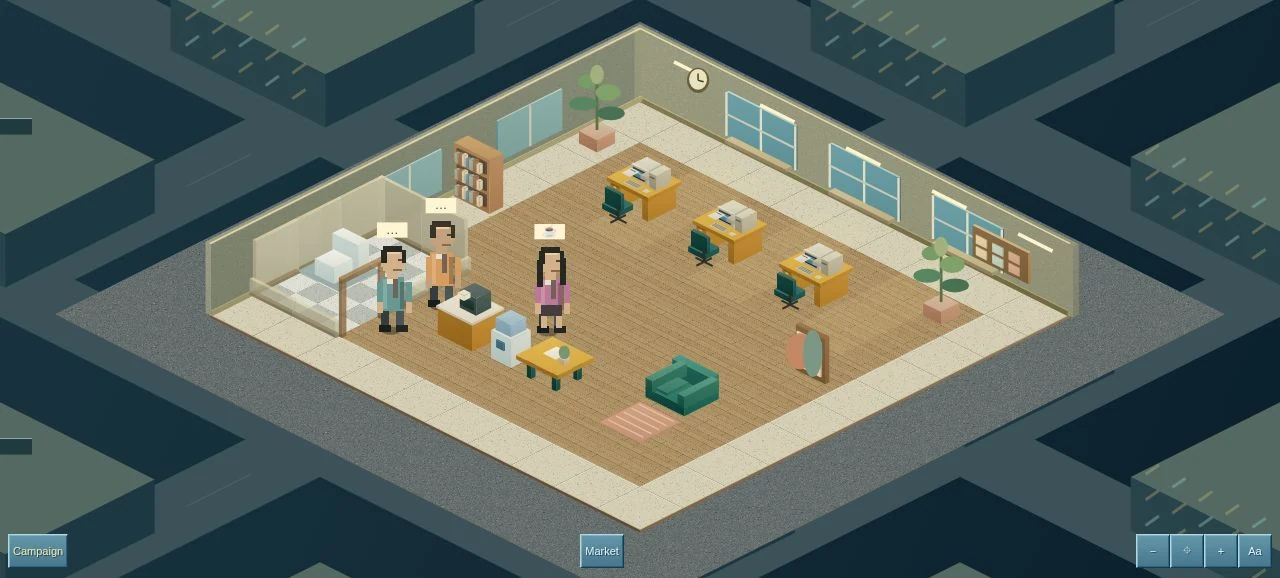
People, products & profit. Furnish your office and hire a team.
Read the Venture Office guide →Grand Hotel
Rooms, service & reputation. Open three rooms and welcome your first guests.
Read the Grand Hotel guide →Harbor & Co.
Trade, transport & production. Load timber and sail to your first buyer.
Read the Harbor & Co. guide →Ironworks
Machines, materials & customer orders. Accept and dispatch your first steel order.
Read the Ironworks guide →For room building, staffing and guest experience, start with hotel management. For production bottlenecks and supply orders, explore factory management. Toothpaste Tycoon includes Jess, an advisor who responds to your factory’s situation. If routes and cargo margins appeal to you, try shipping and trading.
Company management brings people and product development together. Cinema management centers on films, showtimes, ticket sales and concessions. The right first game is the one whose next decision makes you curious.
Campaign or sandbox?
Choose a campaign or scenario when you want an objective to work toward. Grand Hotel, Harbor & Co., Ironworks, Toothpaste Tycoon and Cinema Tycoon have campaigns; Venture Office offers scenarios. Read the starting screen because each business begins with different resources and goals.
Choose sandbox when you want to experiment with the business at your own pace. Sandbox rules differ between games; it does not automatically mean every building is free or every resource is unlimited. Pricing, production and staffing still give you decisions to make. Pause before a large change and inspect the available cash and controls.
If a campaign feels overwhelming, open its beginner’s guide and follow the first step before expanding. A goal gives direction, but you can still pause and learn what each panel shows.
Your first session: build one working cycle
- Inspect before spending. Read the starting cash, existing staff, inventory and first objective. Your business may already have what it needs for its first sale.
- Connect an input to a customer. In a factory, follow materials through production and delivery. In a hotel, connect an available room with a guest and the staff needed to service it.
- Run time at normal speed. Watch one production cycle, shipment or screening. Fast-forwarding before you understand the operation makes shortages harder to diagnose.
- Check results together. Look at cash, sales, costs and the relevant service or capacity measures. A full building is not proof that the business is profitable.
- Change one constraint. Fix a visible shortage, then observe the next cycle. You will learn more from one deliberate adjustment than from buying several upgrades at once.
Common tycoon-game mistakes
Spending the entire cash balance. New buildings and equipment can leave you unable to pay for the supplies or staff that make them useful. Check the next operating costs before expanding. There is no single reserve amount that suits every game or stage.
Confusing revenue with profit. Sales tell you how much customers paid. Profit also depends on the costs of serving them. Cash can move differently again: an equipment purchase or supply order can reduce it before the resulting products sell.
Adding capacity at the wrong step. A faster filling station cannot help a toothpaste line with no empty tubes. More cinema seats do not solve a concession shortage. Inspect the whole operation before deciding what to buy.
Accepting work you cannot finish. Contracts and customer orders have quantities and deadlines. Include delivery times, production capacity and maintenance in your plan. Goods sitting in a warehouse are not always a completed order.
Playing in a browser and keeping your save
All six Tycoon Hub games are free to play without an account or download. They run in a web browser on Windows and Mac. A desktop or laptop provides more room for the management panels; on a phone or tablet, turn the device sideways and use Expand game.
Progress is saved locally in the browser you use. It does not automatically sync to another device. Export a backup from the game menu before clearing browser data or switching devices, then import it in the same game on the new device. Private browsing can discard its stored data when the session closes.
Use My games to return to a business already saved on this browser. For the exact controls, starting resources and production rules, follow the guide for your chosen game.
Choose a business. Make your first move.
Compare the ten games and start a campaign or sandbox.